How to automate your research tasks with AI tools?
As a Researcher, the grind revolves around tasks like—papers to read, data to organize, findings to summarize, and a compelling narrative to craft.
Instead of focusing on generating new insights, most researchers spend a large portion of their time hunting down and organizing information. It’s not just inefficient—it’s a major roadblock to innovation.
But imagine shifting your energy from repetitive research tasks to breakthrough thinking.
AI-powered research automation is a revolution that’s not only streamlining the research process but fundamentally redefining the future of knowledge work.
The Core Idea
At its heart, automating research tasks with AI isn’t about replacing human creativity. It’s about evolving by embracing new tools that foster the boundless creativity and curiosity that define great researchers.
Think of AI as your most reliable teammate—one that handles the demanding, repetitive chores and frees you to focus on exploring bold concepts, drawing unique connections, and crafting a truly impactful narrative with your research.
Global leaders like Google and IBM are setting the pace by:
Embedding AI deeply into their research workflows.
Using AI to tackle scientific and systemic challenges at unprecedented speeds.
Merging brilliant thinking with streamlined execution for groundbreaking discoveries.
For instance:
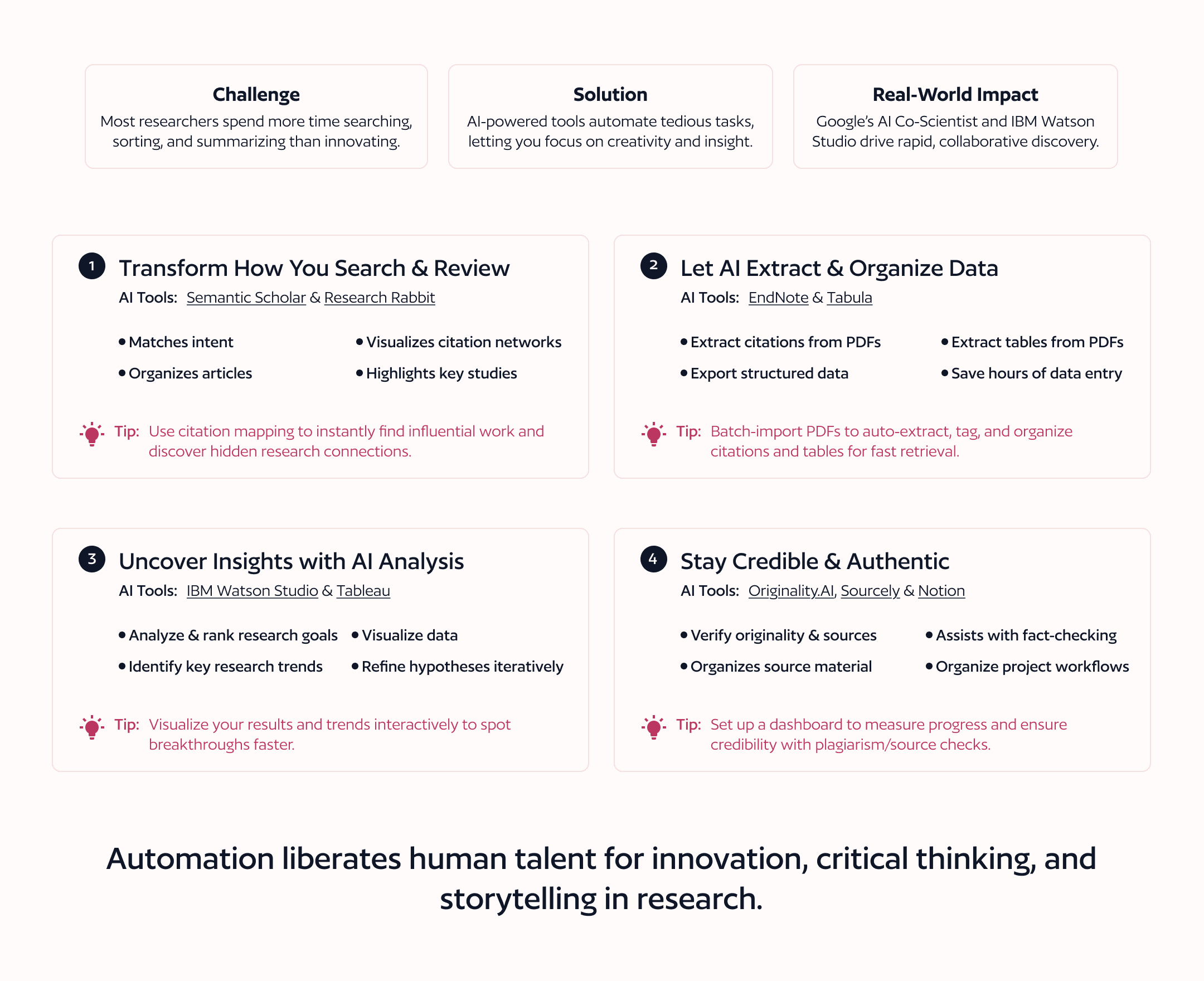
Google’s "AI Co-Scientist" initiative, powered by Gemini 2.0, mirrors the scientific method to autonomously generate hypotheses, refine insights through self-critique, and suggest novel experimental designs. This tool transforms scientists’ productivity by enabling collaboration with AI systems that "think" like researchers.
IBM Watson Studio, on the other hand, empowers multidisciplinary teams to automate machine learning workflows and surface correlations in massive datasets. By connecting predictive technology with intuitive dashboards, they close the gap between insight generation and practical action.
The result?
Faster breakthroughs, greater efficiency, and a renewed focus on purpose-driven research.
The Pain of Inefficiency
Imagine you’re preparing for a systematic review. You have a defined time line and the stakeholders are waiting for updates, and you have a mountain of 700 papers to synthesize before your next meeting.
The process is tiring:
All the papers need to be gathered, read, and prioritized.
Tables and figures require manual extraction, formatting, and validation for analysis.
Critical references must be double-checked to avoid missed papers or duplicated citations.
When these repetitive tasks consume most of your day, they not only rob you of valuable time but also obscure deeper insights. In the end, inefficiency hinders creativity—and innovation stalls.
That’s where automation lifts the burden.
So, how to automate research tasks with AI?
1. Transform How You Search & Review
Cut through the clutter of exhaustive literature reviews with smarter tools:
Semantic Scholar: Organizes articles by topic, highlights influential work, and generates concise summaries to simplify mapping a research landscape.
Research Rabbit: Visualizes citation networks, helping you discover unseen connections and influential research.
These platforms go beyond basic keyword matching by leveraging natural language processing (NLP) to understand the intent and context behind your queries.
You’re not just finding papers—you’re uncovering insights spread across disciplines.
Action Tip:
Use Semantic Scholar’s "Highly Influential Citations" to instantly locate foundational research in a field.
Create a research project in Research Rabbit to visually map the relationships between key studies in your area.
2. Let AI Extract and Organize Data
Spend less time on tedious tasks:
EndNote: Manages large reference libraries by automatically extracting and tagging citation data from PDFs.
Tabula: Extracts tabular data directly from PDFs, enabling seamless export into analysis software like Excel.
Automation ensures you never miss a reference or waste hours formatting datasets—giving creative ideas the time they deserve.
Action Tip:
Import research PDFs into EndNote to batch-extract citations.
For manuscripts with large data tables, use Tabula to quickly transfer structured data into your analysis workflow.
3. Uncover Insights with AI Analysis
AI makes even the most complex data accessible:
IBM Watson Studio: Automates machine learning workflows for quick identification of trends, anomalies, and actionable insights.
Tableau: Combines advanced data visualization with dynamic dashboards, helping you make sense of large datasets in moments.
These tools empower researchers to go beyond hypothesis validation and explore emergent patterns buried in their data.
Action Tip:
Use Tableau to create interactive visualizations of your literature matrix for better understanding.
Try Watson Studio’s AutoAI to build predictive models without needing expert coding knowledge.
4. Stay Credible and Authentic
Ensure your work is accurate and credible:
Originality.AI: Detects plagiarism and confirms the originality of your writing.
Sourcely: Verifies sources in real time to prevent factual inaccuracies.
Notion: Tracks workflows and organizes feedback for iterative project management.
By creating a self-improving feedback loop, these tools elevate the quality of your research while reducing the risk of errors.
Action Tip:
Use Notion to build a centralized dashboard for tracking progress and tool utilization.
Routinely audit article drafts with Originality.AI to ensure credibility.
Balancing Creativity and Automation
Automation isn’t about removing the human touch; it’s about amplifying it.
By automating repetitive tasks, researchers unlock room for creative leaps, dynamic problem-solving, and the kind of bold thinking that changes the world.
Structure creates freedom: AI provides the foundation that lets researchers thrive in their craft.
Efficiency fuels innovation: Liberating researchers from mundane chores means their energy stays focused on breakthroughs.
Global Perspective Meets Personal Impact
From Google’s commitment to accelerating scientific discoveries to IBM’s integration of AI in enterprise-focused research, makes it very obvious that AI tools now bridge the gap between researchers across disciplines, continents, and industries, bringing a global perspective to the most localized challenges.
How to get started?
The window of opportunity isn’t years from now—it’s wide open today.
Reflect: What frustrates you most in your current workflows? or Which repetitive tasks steal time from your best ideas?
Act: Identify one process to automate this week, or Commit to blending AI into your research routines while keeping your creativity at the forefront.
Automate what you can, liberate your human spirit for what truly matters, and transform your journey as a researcher.