How automated resume parsing transforms recruiting?
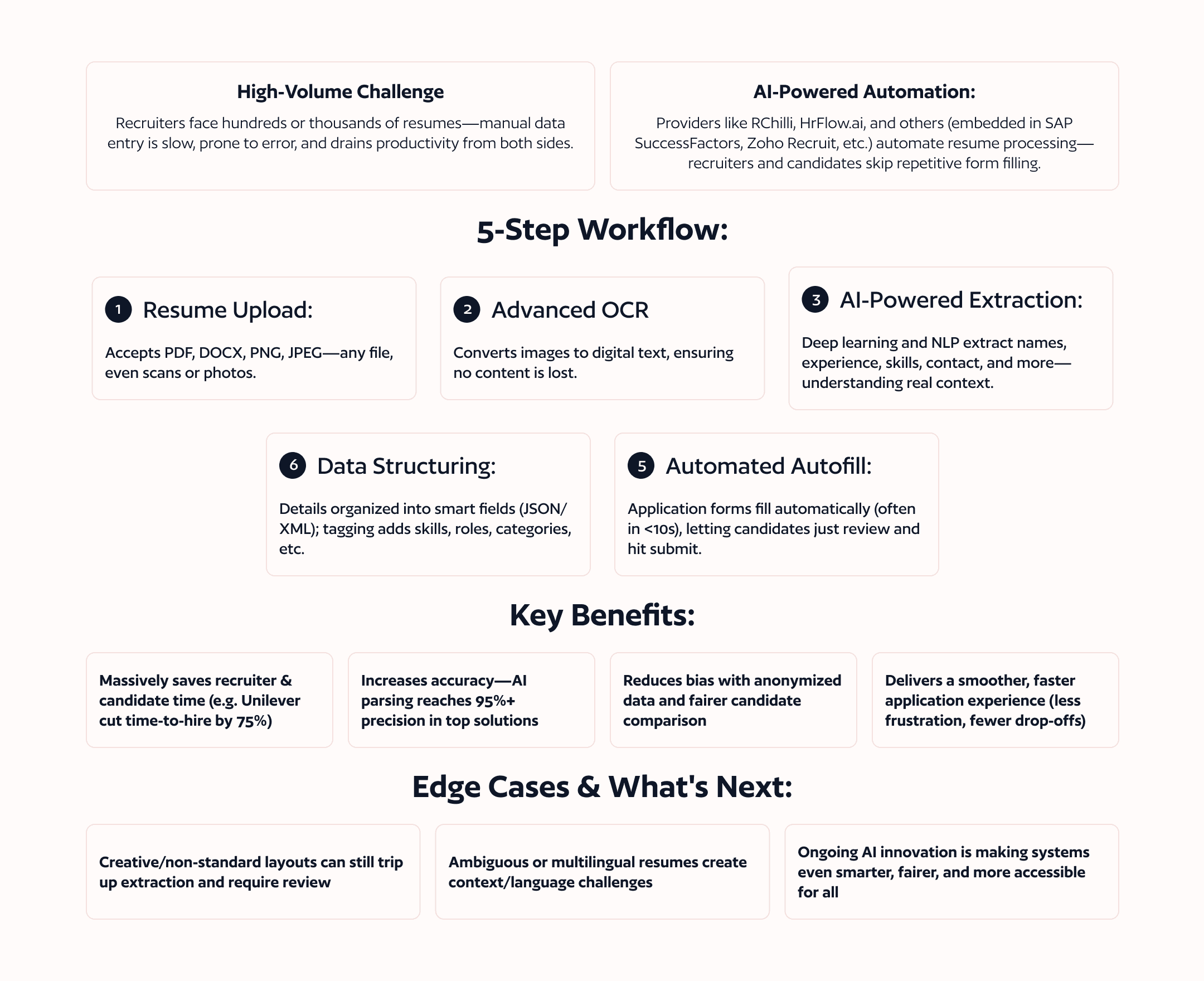
Recruiting often means sorting through hundreds or even thousands of resumes and doing it fast. Manually entering all those details into forms takes up valuable time for both recruiters and candidates.
That’s where automated resume parsing comes in, making the whole process much quicker and more accurate for everyone.
Modern Applicant Tracking Systems (ATS) have moved beyond basic databases. Today’s systems are powered by AI, automatically reading resumes and filling out forms, which removes most of the tedious data entry.
Who’s making this happen?
HR tech providers like RChilli, HrFlow.ai, etc have developed advanced resume parsing modules. These are not just experiments—they’re already built into popular ATS products such as SAP SuccessFactors, Salesforce, Oracle HCM cloud, Capgemini, etc.
Technical Workflow: From Upload to Autofill
1. Document Upload
Modern parsers support all major file extensions and formats, including PDF, DOCX, PNG, JPEG, and many more.
Advanced OCR (Optical Character Recognition), specifically designed for HR documents, enables automated systems to extract text from images, scanned documents, or non-editable formats.
Additional preprocessing steps may include orientation and perspective correction, as well as automatic splitting of large files into multiple resumes and document classification (e.g., cover letters).
2. Deep Learning, NLP, and Context Awareness
State-of-the-art data extraction from resumes uses a combination of Deep Computer Vision and Deep Natural Language Processing (NLP) algorithms.
Context-awareness allows the parser to accurately extract data, even from complex or creative resume layouts, by analyzing semantics rather than relying solely on keywords.
These systems can parse resumes written in 32+ (HrFlow.ai) or 40+ (RChilli) languages, making them practical for global recruitment needs.
3. Structured Data Extraction
The extracted information is converted into structured formats like JSON or XML, where each important detail such as contact info, education, work history, skills, and certifications is stored in clearly labeled fields.
Tagging APIs take this structured data and enhance the candidate’s profile by automatically adding relevant tags or categories (like “Project Management,” “Python,” “MBA”), making it faster and smarter to search, match, and sort candidates in recruiting systems.
4. Automated Form Autofill & Candidate Experience
Resume parsing technologies enable form fields on job applications to be auto-filled in less than 10 seconds, significantly improving the candidate experience and reducing manual data entry errors.
These systems connect easily with Applicant Tracking Systems (ATS) and other HR tools using standard web technologies (called REST APIs) and ready-to-use connectors, so companies can automate their hiring workflows without complex setups.
The structured and parsed information isn’t just for the application; it also helps companies recommend jobs to candidates, improve candidate profiles with more details, and communicate with them through personalized updates or newsletters.
User Experience: Recruiters & Candidates
For Recruiters
Before Parsing: Recruiters struggled with high manual workloads, prone to error and slow candidate screening.
Current Reality: With AI parsing, recruiters upload (or receive) batches of resumes in various formats.
The system automatically extracts details and organizes them for quick screening, candidate shortlisting, and smart matching to job requirements, drastically reducing time-to-hire and increasing accuracy.
For Candidates
Before Parsing: Candidates faced repetitive, tedious application forms, often re-entering details already present in their resumes.
Current Reality: Modern resume parsing supports auto-filling application forms in less than 10 seconds, improving the experience and drastically cutting application time. This ensures a smoother process, reducing drop-off rates and frustration.
Benefits: Qualified applicants are less likely to be overlooked, and bias is reduced through anonymized, standardized screening.
Edge Cases & Downsides of AI Resume Parsing
While AI-powered resume parsing has transformed recruitment, as highlighted on taggd.in, there are still notable edge cases:
Creative/Non-standard Resume Layouts: Many resume parsers have difficulty accurately extracting information from resumes with highly creative designs, extensive graphics, or irregular formatting. This can lead to incomplete or lost data.
Language Ambiguity & Multilingual Challenges: Ambiguous terms (like “MD”) and parsing in less common languages can result in errors or overlooked information. Multilingual support remains a complex technical challenge.
Keyword Dependency/Bias: Over-reliance on keyword matching means that candidates who describe their skills or experience differently might be missed. Context and meaning can be lost if only specific words are recognized.
Bias & Diversity Concerns: While parsing technology helps reduce bias by masking identifying information, faults in anonymization or selective data extraction might unintentionally reinforce biases.
Error Handling & Manual Review Needs: Extraction is not flawless. Manual review and correction are often required, especially for rare roles, certifications, or international resumes.
Automated resume parsing is now central to AI-powered Applicant Tracking Systems and this transforms recruitment by rapidly and accurately extracting and organizing candidate data, dramatically improving speed and experience for recruiters and applicants; and as industry leaders address edge cases like creative layouts, language ambiguity, and bias, the technology promises an even more seamless, fair, and efficient hiring process for the future.